

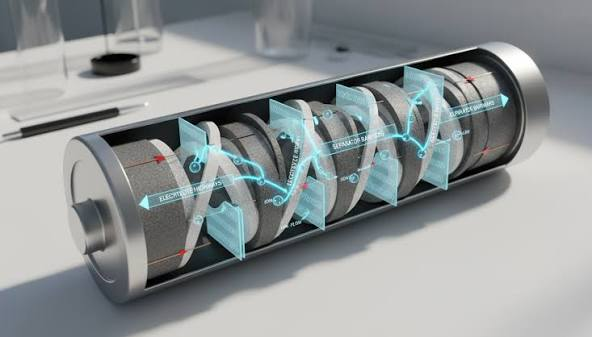
Imagine a city where road works force every driver onto longer detours. The destinations have not moved and the cars have not slowed, yet every trip takes more time and the whole network clogs sooner. Something similar happens to lithium ions inside a vibrated electrode. The pores that carry the electrolyte become more winding, and the journey from separator to particle gets longer. A recent vibration study captures this through tortuosity evolution, a time-varying measure of how convoluted the ion pathways have become.
What tortuosity means
Electrodes are porous. Electrolyte fills the gaps between particles, and lithium ions must thread through that maze. Tortuosity describes how much longer the real path is than a straight line. A value near 1 means a direct route, while higher values mean winding, restricted routes.
Most battery models treat tortuosity as a fixed property of the electrode. Under vibration, that assumption becomes hard to defend.
Why shaking changes the maze
Repeated mechanical loading rearranges the microstructure. Particles shift against the binder, small gaps open, and contacts loosen. The authors argue that these micro-gaps lengthen the effective transport path. To represent this, they let tortuosity grow with a vibration-related damage measure:
τ(x,t) = τ₀ · [1 + β · A(x,t)]
Here τ₀ is the initial tortuosity, A(x,t) is the vibration-driven degradation measure, and β is a sensitivity factor describing how strongly microstructural disturbance lengthens the ion path. With no damage, tortuosity stays at its starting value. As damage accumulates, it climbs.
From longer paths to weaker transport
Tortuosity enters the effective transport properties of the electrolyte. In the model, effective diffusivity and conductivity both scale with porosity raised to a Bruggeman exponent and are divided by tortuosity:
D_eff = D_e · ε^b / τ, k_eff = k · ε^b / τ
So as τ rises, both ion diffusion and ionic conduction fall together. The same tortuosity also appears in the electrolyte mass balance and in the current expression, so the slowdown affects concentration gradients and potential drops throughout the electrode.
A simple illustration, using my own numbers rather than the paper’s: because transport scales with 1/τ, a 20% rise in tortuosity cuts effective diffusivity and conductivity by about 17%, and a 50% rise cuts them by a third. A change that looks small in the microstructure can therefore remove a meaningful share of the cell’s transport capacity.
What happens inside the cell
Once ion transport weakens, a chain of effects follows:
- Lithium-ion concentration gradients across the electrode steepen.
- Regions far from the separator become starved of ions during charging.
- Local overpotential rises, so polarisation increases.
- The cell hits its voltage cutoff earlier, with less usable capacity.
This pathway is one reason the study reports an earlier voltage drop under vibration.
A link to the SOC imbalance
Tortuosity growth also helps explain a headline finding of the paper: the asymmetry between electrodes. The authors point out that higher tortuosity reduces effective diffusivity and conductivity, limiting how easily lithium reaches the negative electrode. Combined with lost active area and rising interfacial resistance, this suppresses lithiation at the anode while the cathode keeps delithiating. The result is an imbalance in lithium inventory, which the study treats as a distinctive consequence of vibration.
What to keep in mind
The approach is useful, but it is worth reading with its limits in view:
- The sensitivity factor is assumed. Direct vibration-specific tortuosity measurements are scarce, so β was chosen within physically realistic bounds based on transport degradation reported in porous electrodes, not fitted to dedicated vibration experiments.
- The framework is simplified. The damage description is spatially averaged, so local blockages and uneven microstructure are not resolved.
- It works alongside other effects. Conductivity loss, contact resistance and SEI growth act at the same time, and the reported behaviour is their combined result.
For these reasons, the numbers are best treated as indicators of trend and relative severity.
Why it matters for design
If vibration lengthens the road, then electrodes that resist microstructural change should age more gracefully. Strong binder adhesion, well-compacted and well-connected pore networks, and mounting that damps vibration before it reaches the cell all work against tortuosity growth. A model with this feature gives engineers a way to compare such ideas quantitatively before committing to hardware, and reminds us that a battery’s pores matter as much as its particles.
